Technical specifications
| Nominal hull length | 16′7″ / ≈5.05 m |
|---|---|
| Beam | 2.41 m |
| Draft — rudders raised | 0.25 m |
| Listed boat weight | 145 kg |
| Sail area — rounded class figure | ≈20 m² |
| Racing crew — class introduction | 2 |
Two hulls, no daggerboards
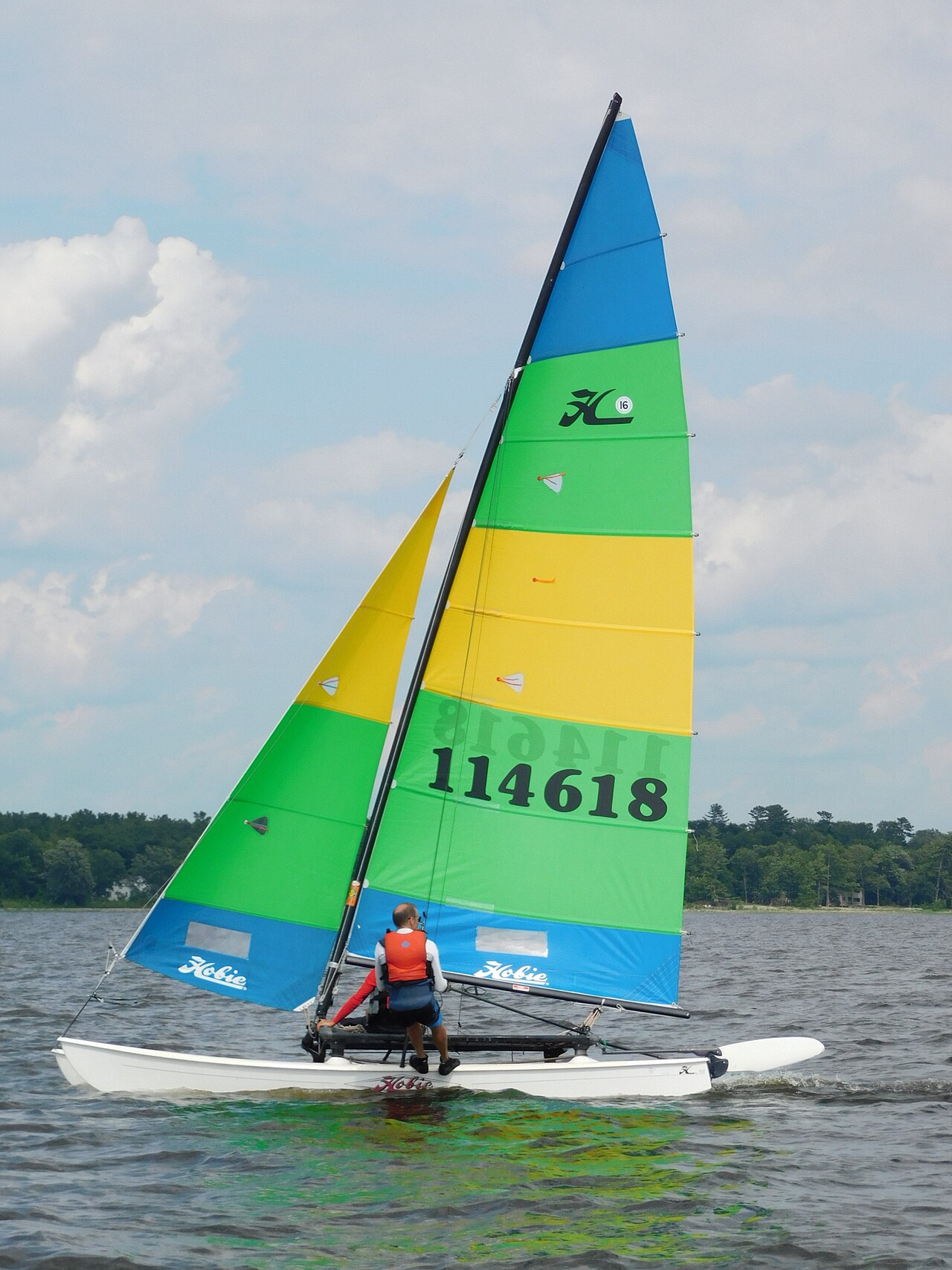
The Hobie 16 is a small sailing catamaran whose hulls supply lateral resistance without separate daggerboards. Two hulls are linked by crossbeams and a trampoline, with the sailors working above rather than inside a cockpit. A mainsail and jib form the standard sail plan. The Japanese Hobie class association identifies a two-person crew and double trapeze, placing crew movement at the centre of the boat’s balance.
Its recognisable curved hull profile is more than a styling cue. It forms part of a beach-cat layout that brings the underwater shape, raised platform and lifting rudders together in one practical arrangement.
Width provides a different sort of stability
A catamaran develops righting moment through the separation of its hulls and the distribution of weight across that span. The double trapeze lets both sailors extend their weight farther outboard. This differs fundamentally from the heavy ballast keel of a monohull cruiser. When one hull rises, the balance is dynamic and the crew must continue controlling sail force and fore-and-aft trim.
The absence of a ballast keel must not be confused with an absence of sailing loads. Mast, rigging, crossbeams and rudder connections all participate in transmitting those loads through the platform.
What shallow draft actually means
The often-quoted 0.25 m draft is explicitly a rudders-up figure. It does not describe the immersed depth of the boat with the rudders fully down for steering. Keeping that qualifier visible prevents a common specification error. Similarly, the approximately 20 m² sail figure is a rounded class introduction value, not an assertion that every sail version has exactly the same measured area.
Construction and equipment can change across production eras and markets. A modern dealer specification and a class summary can therefore use slightly different rounded dimensions while describing the same nominal class.
Reading the rig and platform
In the photograph, follow the jib’s leading edge down to the bridle between the bows and then look at the relationship between mast, trampoline and rudders. These visible connections explain where sails and sailors apply their forces. The class resource and dealer specification linked below provide further equipment detail. This is a technical introduction rather than a rigging procedure: actual assembly, mast handling and righting practice should follow the applicable manufacturer instructions and supervised training.
Sources & further reading
Technical details are based on the sources below. Our explanations are original editorial analysis, not a hands-on sea trial.
- Japan Hobie Class Association — Hobie 16 class specification jsaf.or.jp
- West Coast Sailing — Hobie 16 manufacturer-dealer product specification westcoastsailing.net
- International Hobie Class — official class resources hobieclass.com
Photography
Sources checked: . Specifications may vary by year, rig and configuration; follow the definitions used by each source.