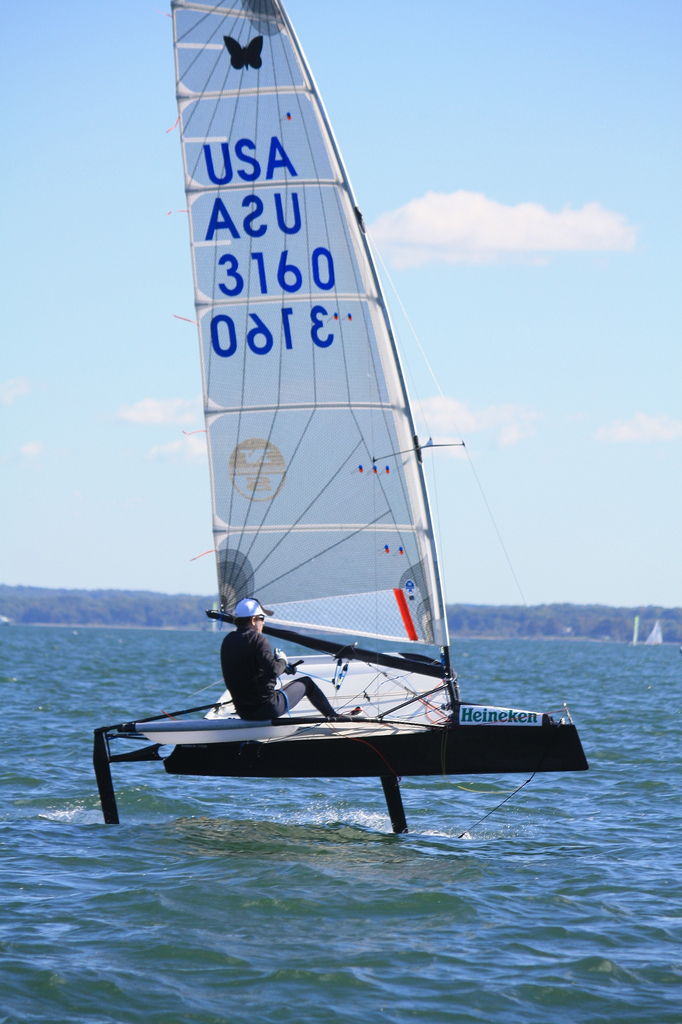
Technical specifications
| Maximum measured hull length — rule 6.1 | 3.355 m |
|---|---|
| Maximum overall beam | 2.250 m |
| Maximum measured rig area — rule 9.1 | 8.25 m² |
| Maximum mast spar length | 6.250 m |
| Racing crew | 1 |
A class rather than a single model
The International Moth is a development class governed by open rules. That means designers have freedom within explicit limits and prohibitions, unlike a tightly prescribed one-design. A “Moth” specification sheet therefore cannot describe every hull, foil package or control system as identical. The association recognises both foiling and lowriding boats; the foil-equipped boat shown here represents one branch of that wider family.
The 2024 class rules limit measured hull length to 3.355 m and overall beam to 2.250 m. The length rule excludes specified removable fittings and contains detailed allowances, so this hull figure should not be confused with the overall storage footprint of a fully assembled boat.
What changes when the hull rises?
In displacement sailing, the hull supplies most of the support through buoyancy. In foiling mode, underwater wings generate lift while moving through the water, allowing the hull to clear the surface. This changes which sources of resistance dominate and adds ride height and pitch control to the sailor’s task. The transition depends on the complete system: foil geometry, rig power, sailor weight, trim and conditions all matter.
A maximum-speed number alone cannot explain this behaviour. The ability to start flying, remain stable through a lull and complete a manoeuvre without touching down describes different aspects of performance.
Measured area is a rule definition
The 8.25 m² ceiling in rule 9.1 concerns the total measured rig area, including the specified part of the mast where applicable. It should not be casually relabelled as an arbitrary manufacturer’s cloth-sail area. The rules also limit mast length and permit only one person aboard while racing. Moving seats, trapezes and multihull configurations are prohibited, preserving important boundaries around the development space.
The broad racks visible on modern boats extend the sailor’s balancing lever while the actual hull remains narrow. The overall beam limit, rather than the hull’s waterline width alone, is the meaningful number when considering that arrangement.
Why universal weights mislead
The class does not impose a universal minimum hull weight. The association publishes typical ranges, not a guaranteed weight for every Moth. Development era, materials and appendages can differ substantially. A comparison needs to state whether it weighs a bare hull or a rigged boat and which foil system is fitted. This profile explains the rules and engineering relationships; the linked official documents remain the authority for measurement and the manufacturer remains the source for a particular boat.
Sources & further reading
Technical details are based on the sources below. Our explanations are original editorial analysis, not a hands-on sea trial.
- International Moth Class — class information moth-sailing.org
- International Moth Class — 2024 rules, effective 1 December 2024 moth-sailing.org
- International Moth Class — official document library moth-sailing.org
Photography
Sources checked: . Specifications may vary by year, rig and configuration; follow the definitions used by each source.