Technical specifications
| Length overall — current heritage page | 17.07 m |
|---|---|
| Beam overall | 9.44 m |
| Draft | 1.50 m |
| Air draft | 28.66 m |
| Light displacement (CE) — current heritage page | 30.3 t |
| Upwind sail area — published configuration | 207 m² |
Accommodation spread over two hulls
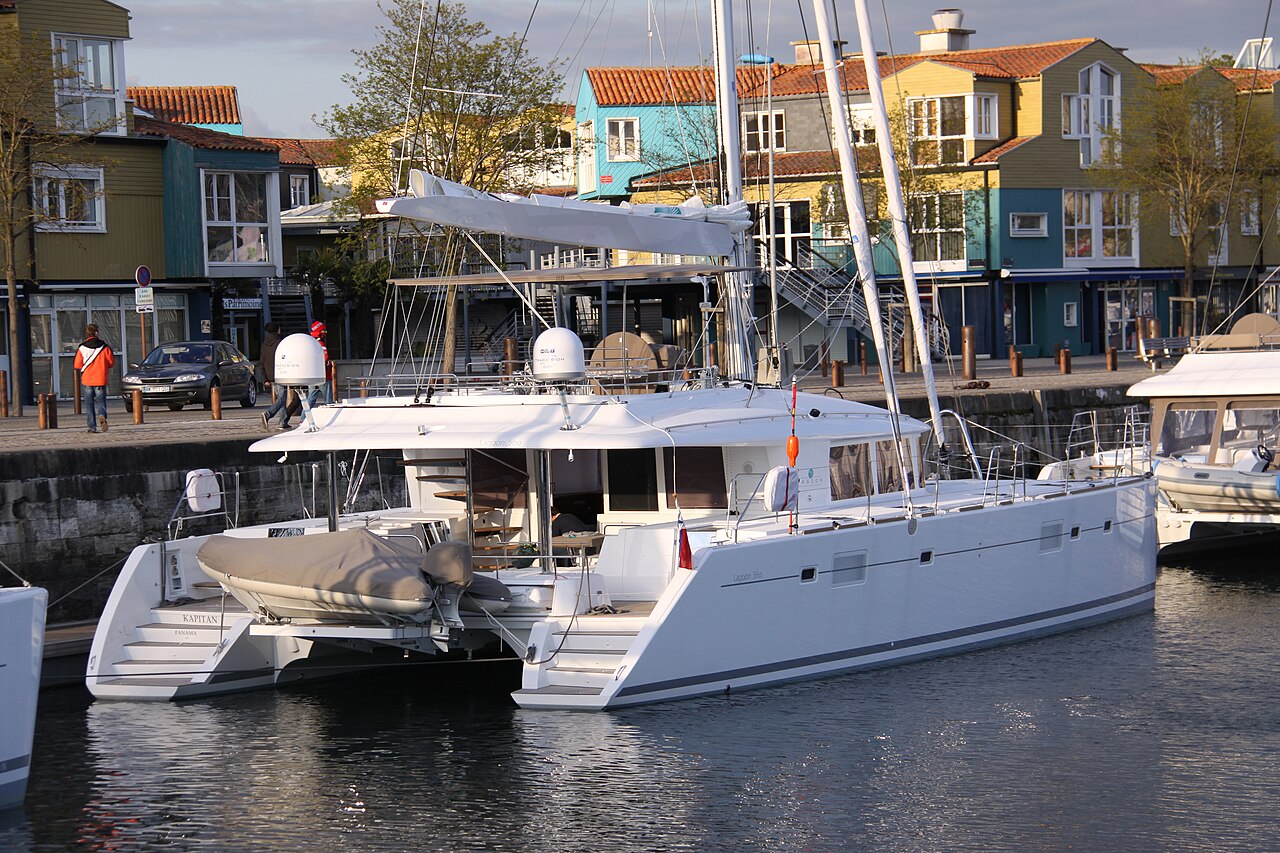
The Lagoon 560 uses two hulls for accommodation and a broad connecting platform for the saloon, cockpit and upper working and leisure areas. This creates a different spatial arrangement from a monohull of similar length. Its 9.44 m published beam is a central fact of the design, affecting the deck layout as well as practical dimensions for a berth.
The official heritage page presents several cabin and galley arrangements. A model name alone does not identify which of these is aboard an individual boat, and a photograph of the exterior cannot establish its internal layout.
Stability and load distribution
The wide separation of the hulls provides form stability rather than relying on a deep ballast keel. That does not remove the need to manage sail area, wind exposure and weight. A cruising catamaran carries stores, water, fuel and equipment distributed across a broad platform; the location as well as the amount of that load matters.
The official page labels its displacement as light displacement under CE conditions. It is not a loaded cruising mass. Comparing that number to a monohull’s fully laden departure weight would mix two different measurement conditions.
The elevated helm changes the viewpoint
A flybridge changes the helmsman’s view and separates some sail-handling activity from the aft cockpit. The relationship between sightlines, communication and routes between levels becomes part of how the boat works. From the stern photograph, the bridging structure and separation of the hulls are easy to see; the official virtual tour adds the interior and upper-deck perspective.
The sail specification includes optional items, including a square-top mainsail and Code 0. A quoted upwind area must therefore be tied to a published configuration. Adding an optional downwind sail to it does not produce an equivalent upwind comparison.
Use the heritage specification carefully
The figures here follow Lagoon’s current 560 heritage page, checked on the stated date, rather than mixing specifications from different production years. Individual 560 and 560 S2 boats may differ in equipment and layout. A documentary profile can explain those design relationships, but it cannot certify the particular photographed boat. For detailed interior images and deck plans, follow the manufacturer’s own gallery and virtual tour; the independently licensed image on this page is credited separately.
Sources & further reading
Technical details are based on the sources below. Our explanations are original editorial analysis, not a hands-on sea trial.
- Lagoon — 560 heritage specification, official gallery and virtual tour catamarans-lagoon.com
- Lagoon — official 560 heritage page in French catamarans-lagoon.com
Photography
Sources checked: . Specifications may vary by year, rig and configuration; follow the definitions used by each source.