These categories overlap: hull count, rig, purpose and construction describe different aspects of a boat. One yacht can belong to several groups.
A home spread across two hulls
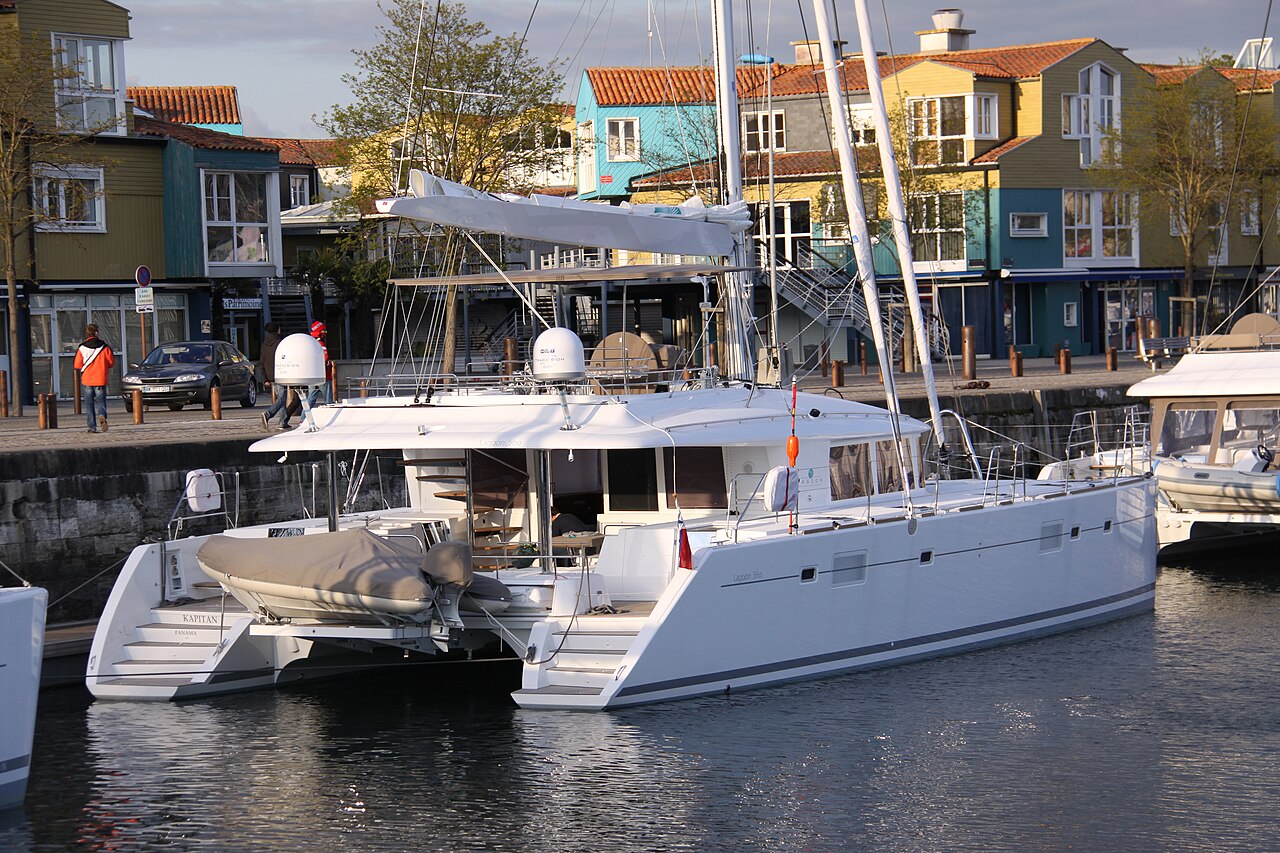
A cruising catamaran places accommodation in two hulls, often linked by a bridgedeck saloon and a broad cockpit. That arrangement can separate cabins while creating a large shared space. Beam gives the platform strong initial stability, so everyday sailing often involves less heel than on a comparable monohull. Motion, however, still depends on sea state, hull shape, loading and heading.
Catamaran describes hull count; cruising describes use. Performance cats, charter-oriented boats and long-distance owner boats can have very different priorities, even when their overall lengths look similar.
Volume and weight must be read together
A spacious platform invites equipment and stores, yet additional weight changes immersion, trim and clearance under the bridgedeck. Light-displacement figures must therefore be kept separate from actual loaded displacement. The weight and location of an added tender, batteries or water affect the result; available locker volume is not a payload allowance.
The manufacturer’s Lagoon 46 page provides one documented example, listing overall beam, draft, light displacement, sail areas and multiple cabin arrangements. Those figures describe that model and configuration, not a standard for all cruising catamarans.
Compare the working boat
Look at visibility from the helm, access to reefing controls, engine and steering access, loading guidance and berth width. Many cruising cats use small fixed keels; others have daggerboards. Two engines can change manoeuvring options, but installation details matter. The absence of a deep ballast keel changes the stability discussion: low heel is not proof of unlimited stability. Read the owner documentation and stability information alongside the attractive interior plan.
Explore real examples
- Lagoon 560 — A large cruising catamaran whose wide platform connects separate accommodation hulls, a central saloon, cockpit and elevated flybridge.
Sources & further reading
Technical details are based on the sources below. Our explanations are original editorial analysis, not a hands-on sea trial.
- Lagoon — Lagoon 46 official specifications and layouts catamarans-lagoon.com
- World Sailing — Equipment Rules of Sailing 2025–2028 sailing.org
- UK Sailmakers — Hull forms and displacement uksailmakers.com
Photography
Sources checked: . Specifications may vary by year, rig and configuration; follow the definitions used by each source.