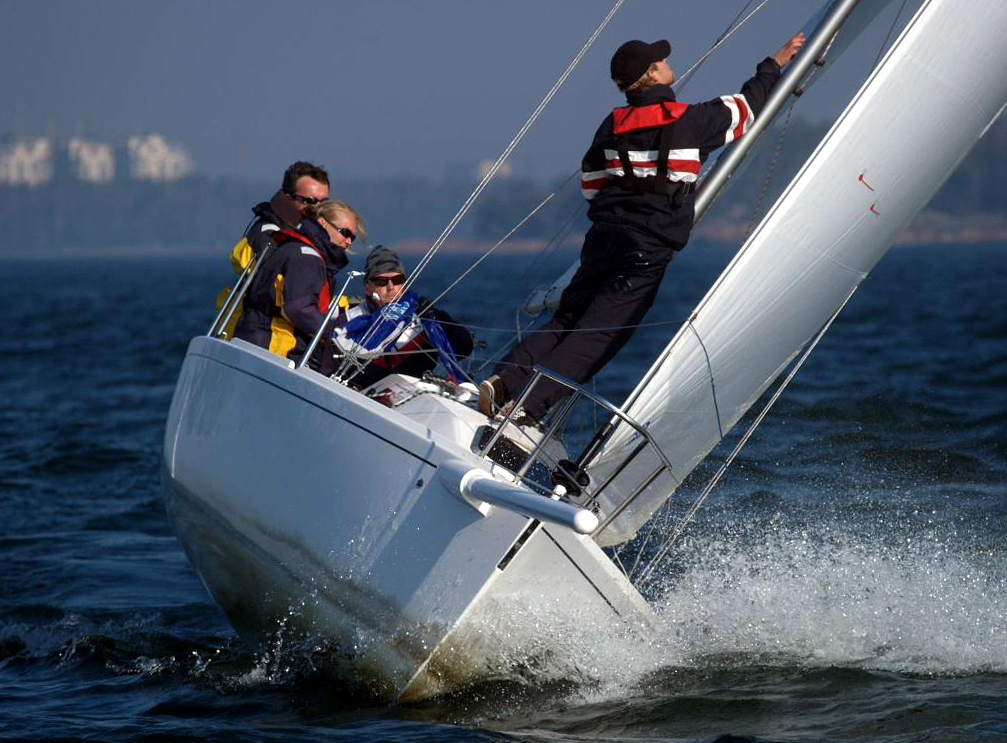
These categories overlap: hull count, rig, purpose and construction describe different aspects of a boat. One yacht can belong to several groups.
A performance brief
A sport keelboat is generally designed to make racing and fast day sailing the priority. Compared with a cruising yacht of similar length, accommodation is often limited and the deck is organised around sail handling. A relatively light hull, substantial sail area and an efficient keel can produce lively acceleration. These are tendencies, not a formal definition shared by every manufacturer.
The keel provides ballast and lateral resistance, yet crew weight and coordinated movement still matter. A keelboat can also be a training boat or a family dayboat; the name describes the design emphasis rather than an exclusive category.
The J/70 as an example
The J/70 uses a lifting keel, a deck-stepped carbon mast, a jib and an asymmetric spinnaker. Its published overall length is 6.93 metres. That combination illustrates the appeal of a compact racing platform: transport and launching can be part of the design brief, while the sail plan supports both upwind work and powerful downwind sailing.
A lifting keel is still a structural, loaded part of the boat. Its transport position must not be confused with its sailing configuration. Storage and launching claims also depend on the complete boat, trailer and facilities, rather than on hull length alone.
A useful comparison checklist
Examine cockpit space, the number of working positions, spinnaker arrangements, keel mechanism and local fleet activity. Distinguish one-design racing, where class rules constrain equipment, from handicap racing between different designs. A technical specification cannot rank the quality of teamwork, the suitability of a launching site or the condition of used sails. Those practical details often decide whether a fast design is also an enjoyable boat to use regularly.
Compare the working upwind sail plan separately from the spinnaker rather than adding every sail into one misleading area figure.
Explore real examples
- J/80 — An 8 m one-design keelboat that pairs a fixed ballast keel with a large cockpit and an asymmetric spinnaker on a retractable bowsprit.
- J/24 — A compact one-design keelboat with a conventional spinnaker pole, overlapping headsail options and a cabin beneath its working deck.
- Melges 24 — A light one-design sportboat whose asymmetric spinnaker, carbon rig and lifting-keel arrangement make crew coordination central to its design.
Sources & further reading
Technical details are based on the sources below. Our explanations are original editorial analysis, not a hands-on sea trial.
- J/Boats — J/70 design and equipment j-boats.com
- J/Boats — J/70 manufacturer brochure and specifications jboats.net
- RS Sailing — RS21 Club keelboat design rssailing.com
Photography
Sources checked: . Specifications may vary by year, rig and configuration; follow the definitions used by each source.